Saturday, July 21, 2012

Website Viewing Hits

So I have software that tells me where I've been and breaks it down by category. I don't know quite how the categories are established, since I'm certain I don't spend 4 percent of my time in "chat" (the last time I chatted online was probably five months ago). I suspect every ad a site serves up gets to be part of the categorizing, so I don't actually have to go to the page (e.g., if I'm in gmail, the g-chat being available, even if unused, perhaps gets categorized).

Anyway, here's how my viewing apparently breaks down for the past week:

Saturday, July 14, 2012

Women I've Been Rejected By

There's no shortage of these, but the chart below focuses on women with whom I had an extended friendship/dating-type relationship. I have always had problems with closing the deal--by that I mean switching over from casual dating or friendship to something more serious, something clearly defined as a relationship, where there's a boyfriend and a girlfriend and all that that entails.

In my life, I've gotten around to the "talk" five times, and each time the result has been, "Let's stay friends, as I'm not interested in something romantic." Here's how long it took for me to get to that point with each gal:
So why does this always happen? (And I'm not being hyperbolic since I've never had a "yes" and thus never had an official girlfriend.) I think there's a combination of factors. One, I probably send off friend signals too much rather than romantic signals (especially because I really try to avoid too much physical touching: I'm more a believer in "courtship" than "dating"; that is, I don't want to do anything with a gal I wouldn't do with anyone else until a relationship is formalized--and wouldn't do most things until the wedding). Still, there are verbal signals one can send, and I really tried to do that before I got rejected this last time a few months ago, but alas whether it worked or not--I still got the same result. Another may be that my asking has often been part of a sense of panic rather than calm: another guy seems to be moving into the picture, one of us is moving away, the gal is spending less and less time with me. Hence, it's been bad timing on my part.

In some cases, part of the reason I asked, though, was so that I would know where I stood with regard to dating so that I could pursue other opportunities without guilt. So in that sense, I was trying to be honorable to the woman I'd been seeing. Sometimes, the "no" was a partial relief, sometimes not--depending on how real and immediate those other opportunities were and how interested I was in pursuing them.

I suppose one good thing for those who I ask is this: they end up married within a few years. The only one still single is the one who just rejected me. How long will she stay on the market? We'll see.
 
This other chart shows the time it took to end the possibility of a relationship with women I went out with for a period, who I never got around to asking for one reason or another: (1) I had serious intentions but the gal made clear we would only be friends before I ever got to a point where I felt certain enough about my own goals to ask; (2) the gal rejected me by disappearing because I wasn't sufficiently into her (which is true: I probably never would have asked); or (3) the gal threw herself at me (i.e., she brought up "the talk" rather than me), and I had to turn her down (in each case we remained platonic friends afterward, as we were before).
It's easy to boohoo when I get rejected, but the above chart shows that I've disappointed my share of women as well (and I'm probably not even listing all of them, since there wasn't a formal time when I had to do the rejecting in most cases).

I used to think it was easier to get rejected than to reject, but when I think on those friendships I've charted above, the hardest ones, in my memory, have been those I was rejected by. What I think I really meant, when thinking that rejecting was harder than being rejected, is on the short term: after one date or something like that, because it feels much more superficial in those cases: how can I reject this person to whom I have hardly given a chance and who by every indication is wonderful but who doesn't at all light my fire and who I suspect never will? Cases, in other words, where my heart says one thing but my head another. If the yellows in the bottom chart had actually asked rather than disappearing, perhaps my feeling would be that rejecting is harder, since two of those were clearly head versus heart cases.

Saturday, July 7, 2012

Grade Point Average and Standardized Tests

A few years ago, I was reviewing my grade reports from elementary school and was surprised to find that I was not that good of a student, since by college I was getting a 4.00 consistently.

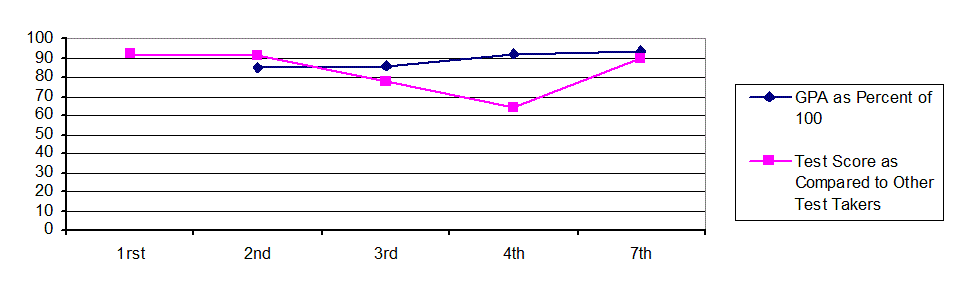
Well, today, I went back to those records and was actually surprised to see that I really wasn't as bad as I thought--and that I also wasn't that good. What kept me from the 4.00 consistently through high school was almost always physical education; in elementary, penmanship could be added to physical education as a bane to my grade level (though I got B's and C's in other classes as well, especially early on).

Neither penmanship nor physical education were things I had to worry about in college, so my grades improved accordingly, though there were a few classes I was almost certain I'd get a B in and somehow squeaked by with the A. C below equals college (I did 5.5 years, as I worked full time for most of my undergraduate years), G equals grad school.
Not surprisingly to me (as I knew this as well), my standardized test scores dropped throughout elementary, though there wasn't as much correlation between higher grades and lower standardized test scores as I thought. And apparently, in seventh, I was back to being high on those test scores (too bad that wouldn't stick through the SAT and GRE, where I did above average but nothing close to scholarship level).
Another interesting thing about those standardized tests. I did exceptionally well in the language portions of the tests early on but not as well at the math. I remember not quite understanding many math concepts when I was younger. By seventh, my scores reversed--math had become my strong suit, but language not as much. That said, where I largely faltered in language was with vocabulary, something that to this day I do not test well in, whereas I do very well with comprehension or grammar. Probably, the problem with vocabulary for me is that those tests often pose words out of context, and for me, context is key to my understanding.

Saturday, June 30, 2012

Car Colors

I've only owned three vehicles, each of them in a different color. Here are the vehicle colors that have thus dominated my life:
I didn't realize I'd owned the car I have now for so long (seven years). Hard to believe how much time has passed since I purchased it.

Saturday, June 23, 2012

Number of Stories Accepted, Rejected, or Ignored per Year


I've felt like this past year has been one in which I haven't seen very many acceptances of stories for publication, and a review of statistics shows why. In 2009 and 2010, I had an unusual number of acceptances, it appears. The 2011 figures aren't completely in, since I generally give it one year before declaring a submission ignored, so those 26 ignores for 2011 may come down by some number by the end of 2012. Still, the chances of me seeing again the number of story publication acceptances I had for 2010 submissions is unlikely. (By contrast, I've seen quite a bit of poetry being accepted after a couple of years of total drought.) (Note, I didn't start logging whether a publication commented on a rejection until around 2000.)

Saturday, June 16, 2012

Number of Submissions before Acceptance

I recently saw a blog documenting people's number of submissions before their first acceptance of a story by a publication. One guy had submitted a piece fifty-nine times before it had been accepted somewhere (and for pay). Some people put up some rather surprising numbers in terms of percentage accepted (in the realm of about 30 percent, whereas others were more in my realm of 2 percent).

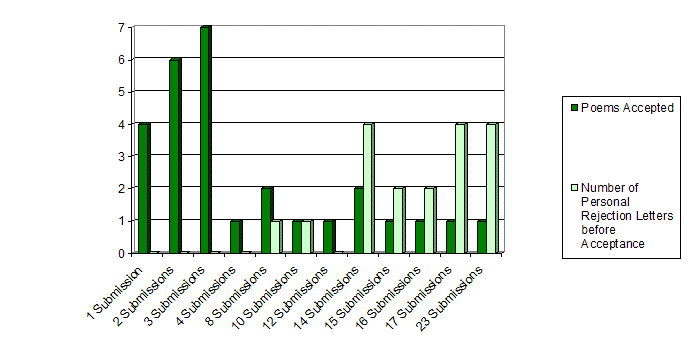
Anyway, the blog made me wonder how many rejections each published piece had to go through before being accepted. I've broken it out by short stories and poetry. Let's look at poetry first:

Interestingly, if a poem is going to be accepted, it looks like it has the best chance of happening within the first three submissions. That said, as the number of times I submit a poem goes up, so too does the likelihood that an editor will note liking the poem but not accepting it.

Now let's look at stories:


Pretty much, the same rules hold up for stories as for poems, though stories appear to be much more difficult to have accepted, at least for me.

Saturday, June 9, 2012

I Write Like

Having read how little analysis went into how this guy created this program (which can be found here), I don't think it can be taken too seriously. That said, I was curious to see how my own work would fare. So who do I write like? Well, if we're talking poetry, I write the most like James Joyce, as shown in the chart below:


The assorted others (each with one poem) were Margaret Atwood, Ray Bradbury, Raymond Chandler, Stephen King, Rudyard Kipling, H. P. Lovecraft, Chuck Palahniuk, Edgar Allan Poe, Mark Twain, and Kurt Vonnegut. (I wasn't even aware some of the people wrote poetry!)


For stories, it's another matter. When I first found this site and pasted in single paragraphs, I kept coming up with Cory Doctorow, whose work I didn't know (but I plan to read, now that I know of him) and occasionally Dan Brown or David Foster Wallace (ironically, most often with letters).


Paste in full stories, however, and my writing most often resembles Chuck Palahniuk, especially my early published stuff. Later stuff trends more toward Cory Doctorow. Here's the breakdown:


As for this blog entry--apparently you're reading the work of H. P. Lovecraft.